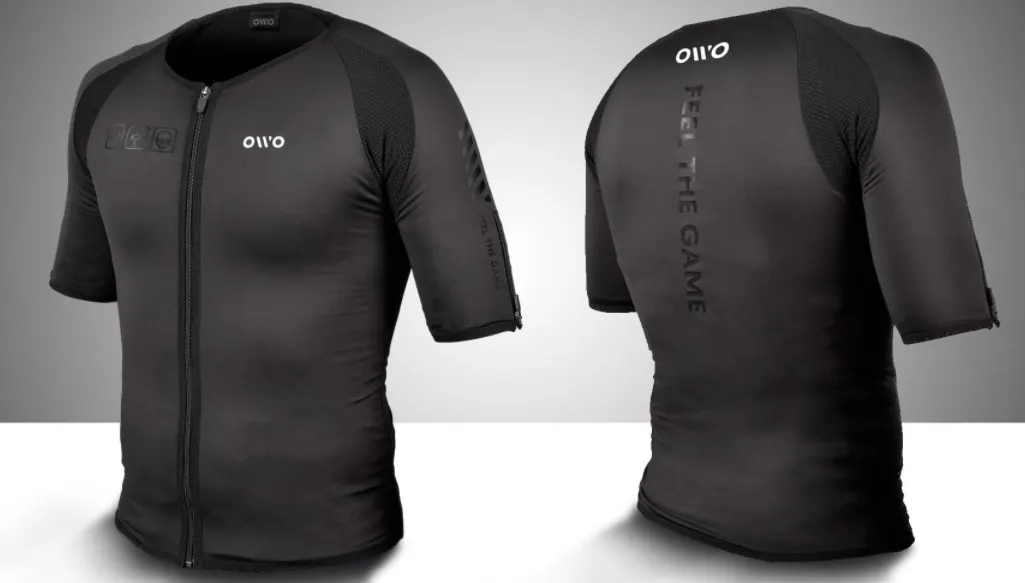
Hands-On: OWO Haptic Vest
 Mat Pawluczuk·
5 MIN READ
Mat Pawluczuk·
5 MIN READ
A VR/XR haptic suit capable of simulating pain, discomfort, and other, more subtle sensations

Even if you never considered buying a haptic vest, you still might have heard of OWO. The company produces a gaming-first haptic shirt that creates feedback using electrical stimulation. This unusual approach made OWO go somewhat viral. Some find it controversial. Others find it unmatched. Either way, I had a chance to try the suit at AWE, and here is my hands-on review.
Short verdict: Genuinely different and adrenaline-inducing, but quirky and not for everyone.
Comfort & Ease of Use
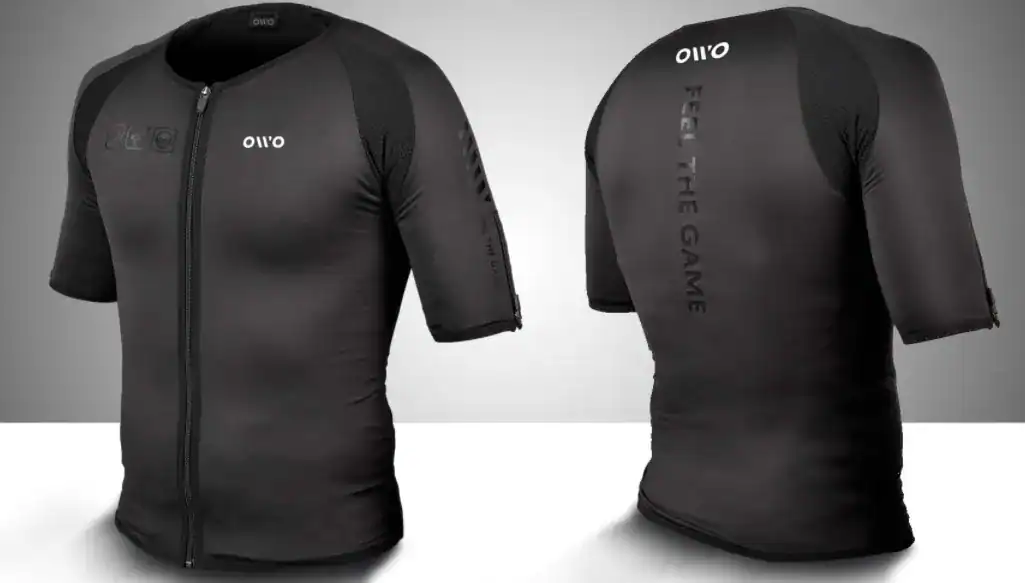
Putting on the vest was easy. Impulses are sent to muscles using high-conductivity electrodes. These are embedded inside so there is no need to fiddle with the electrodes or place them on your body individually. As long as the vest hugs the body tightly, everything should work.
What this means, however, is that the shirt does have to touch your skin directly. This can be problematic for a couple of reasons. First, sharing the vest with your friends seems out of the question, which for a $400 device is a bit disappointing. Second, even though AWE staff cleaned and disinfected all the vests, many visitors still had understandable reservations. Having to go to a changing room, especially at a public convention, is not something attendees usually expect.
Thus, while in terms of setup the OWO Vest is no more complicated or time-consuming than the other haptic vests, there is a degree of oddness that comes with the territory.
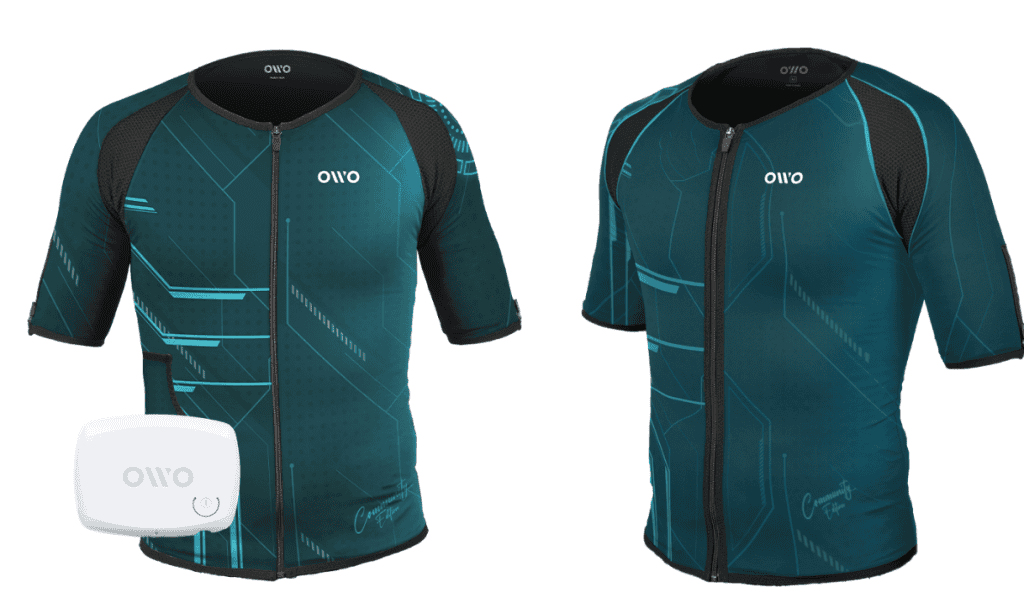
When it comes to design, the classic blue and white shirt, which I personally found quite slick, is no longer available. Buyers can select the Community Edition, which offers a more custom, futuristic look, or the standard black version.
First Impressions
What I noticed immediately was the wide range of haptic sensations provided by the vest: pulse, recoil, hug, hit, just to name a few. I wasn’t just getting zapped. Sensations range from sharp and localized, like a puncture or a stab, to subtle and general, such as wind, rain, or the heaviness of a virtual backpack. Even something as abstract as being low on health can be simulated meaningfully. And yes, if someone really wants to, they can take it beyond safe territory and into the realm of what people describe as pain.
I can say that confidently because when it comes to intensity, I decided to go all in and set the power between 35 and 40 volts (staff told me that the average is 7 to 15 volts). While this might seem excessive, I was eager to see just how intense the vest can feel and how it would handle what I consider my personal threshold.
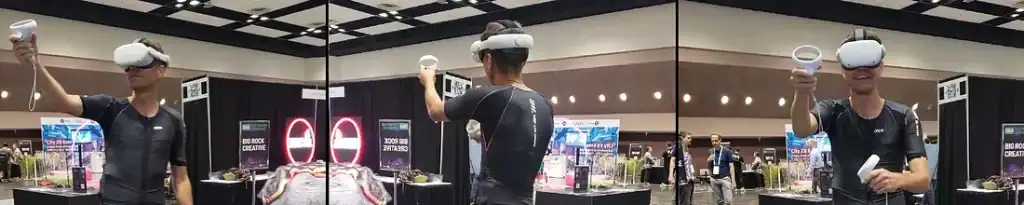
Interestingly, even at such high settings, the feeling was not what I would describe as typical pain. If anything, it’s more like discomfort akin to small muscle spasms rather than stings.
Despite its short-sleeved design, the suit can emulate trigger and wrist feedback. I had a chance to try the OWO Vest with both its proprietary drone demo and a well-known VR game, Pistol Whip, and came away buzzing with adrenaline from all the muscle stimulation.
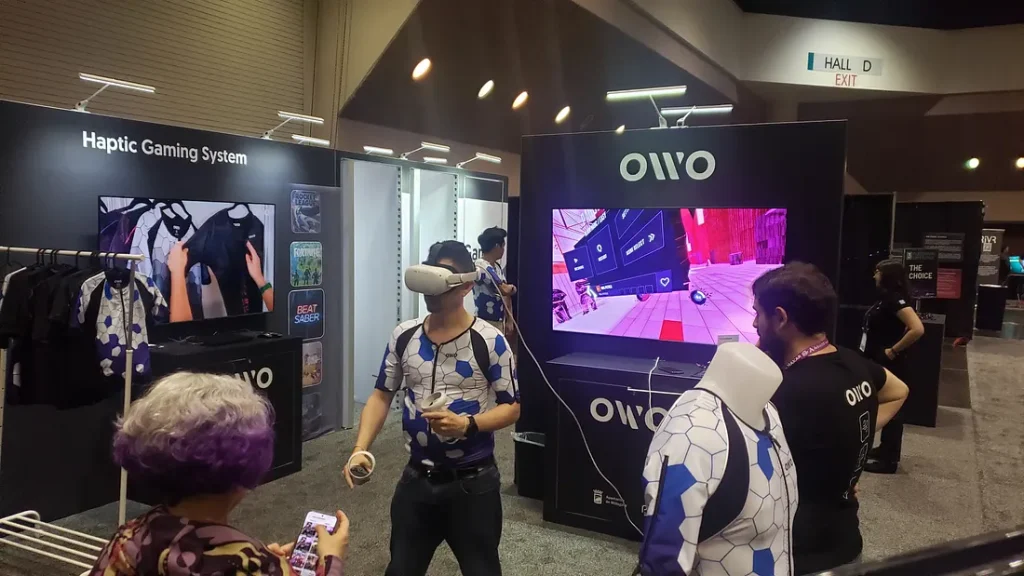
The OWO vest is accompanied by a mobile app that lets you customize the intensity of each electrode individually. If I had more time, I would definitely give this option more attention, because intense high-voltage settings make sense only in certain circumstances. For example in action games and around the area of your body that is subject to enemy attack. For many other sensations, such as pulling the trigger or slicing blocks in Beat Saber, high voltage can be counterproductive.
In my case, since I set all sensations to a uniform level of 35 to 40 volts, every time I pulled the trigger in Pistol Whip, my index finger received a high-intensity zap. By the end of the map, I found myself unwilling to keep shooting. It is obvious that for such basic interactions, low voltage would suffice, and the companion apps makes such customization possible.
The app also features a showcase mode that lets you try various haptic combinations that the vest is capable of producing, including abstract pulsating or vibrating patterns. These can be quite elaborate and make good use of the electrodes, offering unusual sensations that are not just zaps and shocks.
Closing Thoughts
The OWO gaming vest left me impressed. The intensity definitely works to enhance immersion, making in-game elements more visceral, and, in turn, more realistic. The drones from OWO’s proprietary demo suddenly became much more menacing and intimidating. They even seemed to appear improved graphically — my mind was willing to fill in the blanks and appreciate these low-poly models as more detailed than they truly were. These perceptions are all mind tricks created by our internal fight-or-flight system, and it was quite interesting to experience it firsthand.
This brings us to the main question of whether the OWO vest is worth $400 and whether it is better than the TactSuit Pro. There is no obvious or definitive answer to that. The suit’s biggest selling point is that it can not just simulate haptic feedback but also generate unpleasant feelings. This is something you just cannot get with the TactSuit, no matter how many motors bHaptics incorporates into its vest.
At the same time, even a slightly uncomfortable experience might not be something the mainstream consumer is interested in pursuing. While getting shot in VR is not supposed to feel pleasant, a lot of users are okay with the less-than-realistic approximation that the TactSuit Pro or the Woojer Vest 4 provides. But in the case of OWO, lowering the intensity all the way down to make feedback subtle and agreeable defeats, in a sense, the entire purpose of the vest. After all, the TactSuit Pro can provide subtle and agreeable feedback just as well without you having to take your shirt off.
It seems the OWO vest is designed to appeal to those willing to push their comfort zone a bit. Judging by how OWO is doing in the market, the number of gamers that share this attitude must be substantial, or else the company would not be in business. As Viggo Mortensen said, pain is your friend.