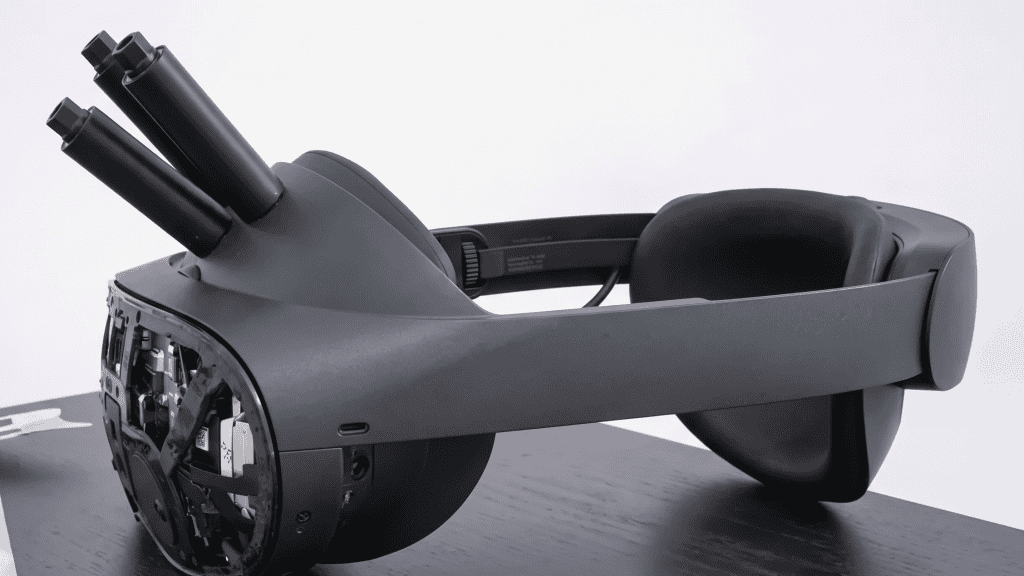
The VR headset that will literally kill you if you die in-game
 Mat Pawluczuk·
7 MIN READ
Mat Pawluczuk·
7 MIN READ
Codenamed OQPNVG, it is the only existing headset designed to kill its user when they die in-game.
I write about XR a lot, but no matter what subject I’m covering, there’s always a subset of search traffic that came looking for something else. They want to know about the ‘VR headset that kills you.’

This article goes out to all of those readers. Consider your curiosity officialy satisfied.
Is the headset real?
It might be hard to believe but it is indeed real. The headset, called OQPNVG, is the brainchild of Palmer Luckey, an eccentric creator of the Oculus brand and Oculus Rift headset. You might know him for reviving the virtual reality industry in the mid-2010s and famously selling Oculus to Facebook for two billion dollars. Facebook later rebranded to Meta and became one of the leaders in immersive space. As for Palmer, he was ousted from Facebook and went on to create Anduril, a defense technology company that specializes in autonomous military systems.
So why did Palmer create OQPNVG? Why create a headset that kills you? Is it a weapon? Or was he just feeling morbid? Well, neither.
OQPNVG is one of the many side projects that Palmer always works on. For example, in June 2024, he announced the ModRetro Chromatic, a retro handheld compatible with Game Boy and designed for the premium market, and in July 2026, he released the M64, a gaming device compatible with another classic console Nintendo 64. Both products were very well received, but from a business perspective, they are neither virtual reality nor military tech. Palmer created Chromatic and M64 because he simply felt like doing so. In a similar vein, Palmer pledged to create, before he grows old, a fully functional bipedal mega-mech. Acknowledging that use cases for such a mega-mech might be somewhat limited, he still confirmed his desire to build one “tactical utility be damned.”
Therefore, it’s not entirely surprising that out of all the people in the tech industry, he was the one to take the idea of *if you die in game, you die in real life* seriously and actually make an functional prototype.
What’s behind the OQPNVG name?
OQPNVG takes inspiration from Sword Art Online, or SAO for short. In case you haven’t heard about SAO, it’s an anime about a virtual reality game. In the anime the game gets hacked trapping thousands of players inside. Any player who tries to forcibly remove the headset gets killed with high-frequency microwaves, and if the player’s in-game health goes down to zero, this also triggers the death mechanism. Ergo, if players die in the game, they also die in real life.
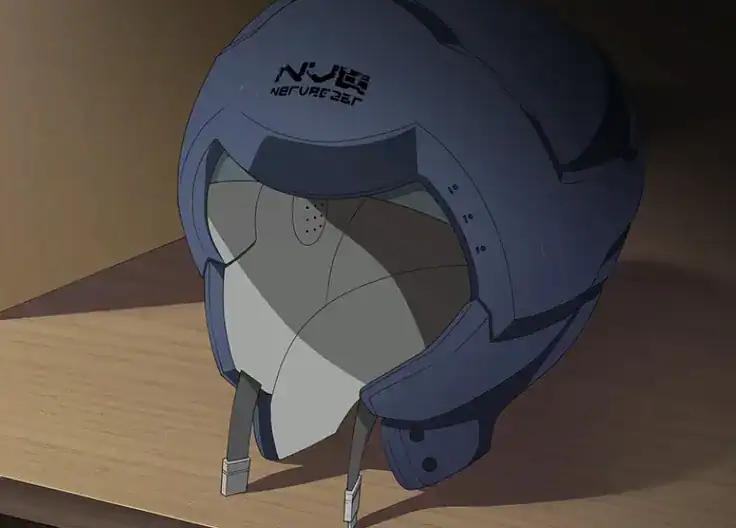
The OQPNVG headset is a direct homage to that show. Palmer Luckey announced the headset on the 6th of November. This isn’t a coincidence. In the anime, players get trapped inside VR exactly on November 6. It’s also worth noting that SAO is a Japanese franchise and is even more popular in Japan than in the States. In 2013 and 2014, the Japanese SAO fan community became almost obsessed with Palmer, and comparing his Oculus Rift to the fictional NerveGear device. In this context OQPNVG can be seen as a nod of appreciation from Palmer toward his Japanese friends.
That is why Palmer, in a tongue-in-cheek post, remarked that he’s got some good news and bad news. “The good news is that we are halfway to making a true NerveGear. The bad news is that so far, I have only figured out the half that kills you.”
So, what does OQPNVG stand for? There have been various attempts to decipher the acronym. Eurogamer suggested it might be “Oculus Quest Panoramic Night Vision Goggles,” but I’m almost certain the name stands for “Oculus Quest Pro NerveGear.” That’s because the headset is built on top of Meta Quest Pro, which Palmer renamed to emphasize its Oculus lineage. The NVG means NerveGear and is yet another homage to Palmer’s beloved SAO franchise. It seems the mystery behind the headset’s name is finally solved.
How does OQPNVG work?
Unlike NerveGear, the OQPNVG device doesn’t kill using microwaves. Palmer admits he tried to recreate such a scenario but found it impossible to engineer (at least without adding “gigantic pieces of equipment”). So instead, he opted for a method that’s a bit more crude and attached three explosives on the top, giving the headset its distinctive look.
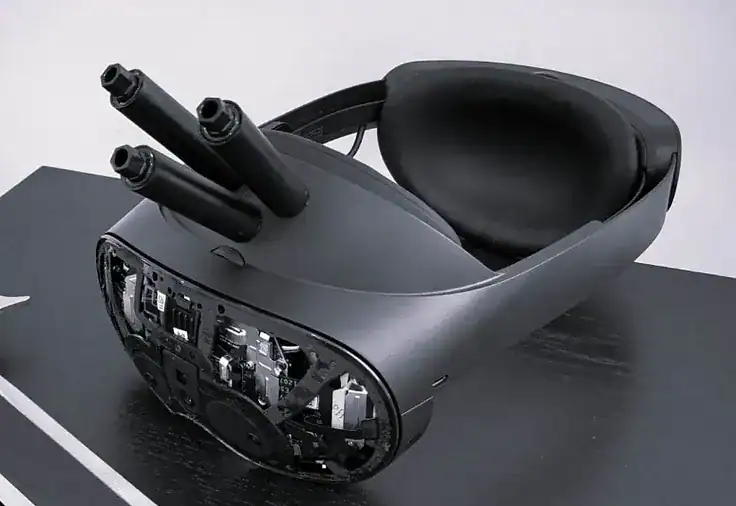
The three horns in the photo are the explosive modules that detonate when the screen flashes red at a specific frequency. According to Palmer, this solution makes implementing a kill switch very easy for developers. Palmer did not mention how powerful the charges are, but said they are strong enough to instantly “destroy the brain of the user.”
Currently, no anti-tamper mechanisms exist, so unlike the fictional NerveGear headset, OQPNVG can be taken off without risk. Overall, Palmer confirmed that both the explosives and the kill switch are very real, fully functional, and not just conceptual, but at the same time, admitted he wasn’t brave enough to try it out himself.
“There are a huge variety of failures that could occur and kill the user at the wrong time,” he wrote, adding that “like in SAO, the final triggering should really be tied to a high-intelligence agent that can readily determine if conditions for termination are actually correct.”
Specs and Price
The OQPNVG headset runs on top of Meta Quest Pro, so its specs are more or less identical. OQPNVG features a Qualcomm Snapdragon XR2 processor and 12 GB of memory. Users can log into their Meta accounts and play existing games from the Meta Store, but dying in those games will not result in dying in real life. For that, developers would have to update their games to include the specific-frequency flash mentioned earlier, and so far, we haven’t heard from any developer planning to do so.
The OQPNVG is not available for sale, and I am not sure whether it could ever be. A device that presents such a huge self-harm risk and isn’t a weapon would face numerous legal challenges. For now, more than anything, it’s a thought-provoking art piece, although Palmer does mention it’s the first “non-fiction example of a VR device that can actually kill the user,” conveying that it’s closer to what we could call performative hardware, rather than just pure art.
Reception and closing thoughts
Upon the announcement, many people took to X (formerly Twitter) to express their outrage. I found it both fascinating and baffling that so many thought OQPNVG was intended as a mass-market consumer product.



These replies, together with the viral notoriety the headset gained, prove OQPNVG tapped into some kind of morbid fascination that we collectively share. One could argue that this goes back to Mesoamerican ballgames or gladiator fights where human beings were made to compete in purpose-built spaces and where the stakes could not have been higher. Such activities have long been outlawed but persist as part of our collective psyche, for example, in movies and books, and my guess is Palmer’s headset revives that universal thrill of life-and-death stakes, but in the VR era.
I don’t think I would ever dare to try OQPNVG, but I did try the OWO haptic suit. It’s a haptic shirt that can simulate various unpleasant sensations, including pain. In short, even though I couldn’t die and the risk was minimal, the OWO haptic suit did alter my experience significantly. With a real threat of pain, the enemies and the game suddenly appeared much more menacing and serious. Fight-or-flight instincts kicked in. Unlike OQPNVG, the OWO shirt is actually available for purchase, so for those of you who want to push the limits without risking having your brain blown to pieces — I’d say that’s the next best thing.