Dataminer Luna Details Meta’s Next Headset
 VR Guru·
4 MIN READ
VR Guru·
4 MIN READ

Is Meta ready to announce its next headset at this year’s Meta Connect scheduled to take place on September 23 and 24? A lot seems to suggest so, and thanks to a genuinely exhaustive leak roundup from dataminer Luna, published on UploadVR, we now have a much clearer picture of what Meta’s next XR device is shaping up to be.
Successor to Quest Pro
Let’s start with the fact that Phoenix is not the same as Quest 4. It is a spiritual successor to the Quest Pro and likely positioned as an Apple Vision Pro competitor. A separate, gaming-focused Quest 4 is supposedly still in the works, landing in 2027 or even as late as 2028. Without getting into the details, Meta originally had a plan for Quest Pro 2 codenamed “La Jolla,” but after the headset was canned, the company pivoted its resources toward shrinking the form factor and making sure it could cram as much as possible into something as small as possible. When asked about it, Meta’s CTO Andrew Bosworth has quoted John Carmack’s old line, “simplicate and add lightness” (originally attributed to Colin Chapman), which probably best sums up the direction of this pivot.
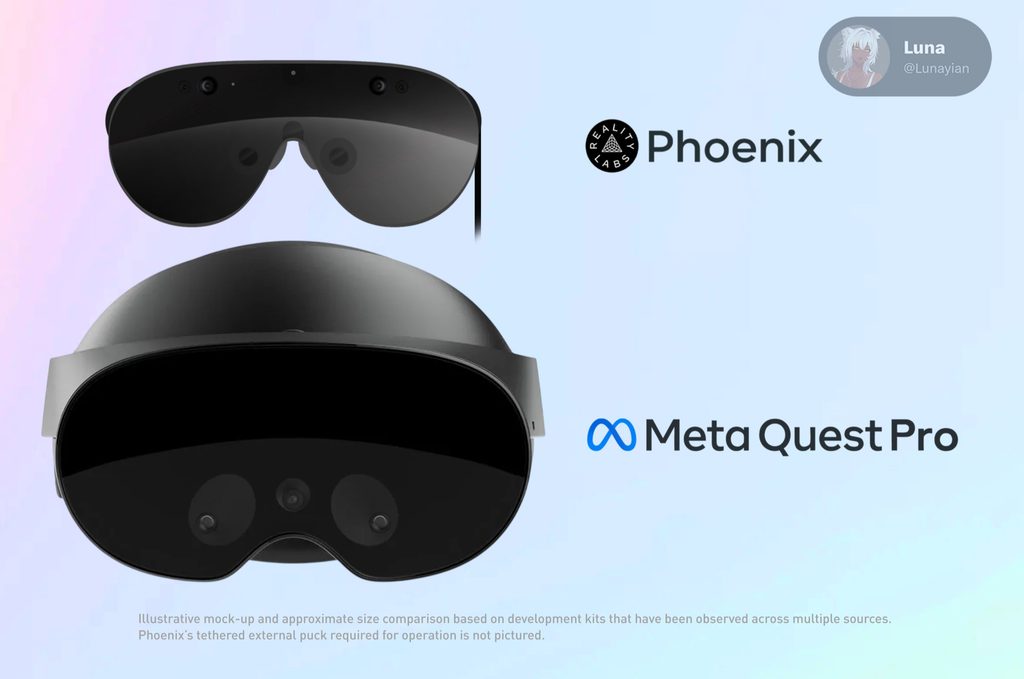
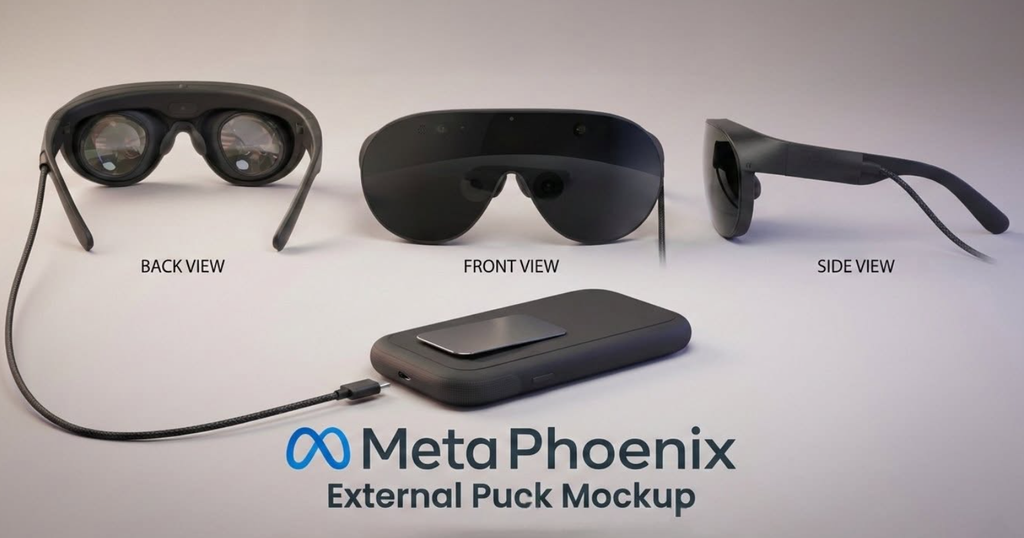
Phoenix is a passthrough VR HMD (meaning it does not have transparent lenses and instead uses outward-facing cameras to deliver mixed reality) but the profile is radically slimmed down and closer to a chunky pair of display glasses than a traditional headset. It rests on your nose with adjustable, swappable nose pads rather than a halo strap or facial gasket, and the temples fold in like normal glasses. To achieve that low weight, Phoenix is tethered to a compute puck that clips to your waistband.
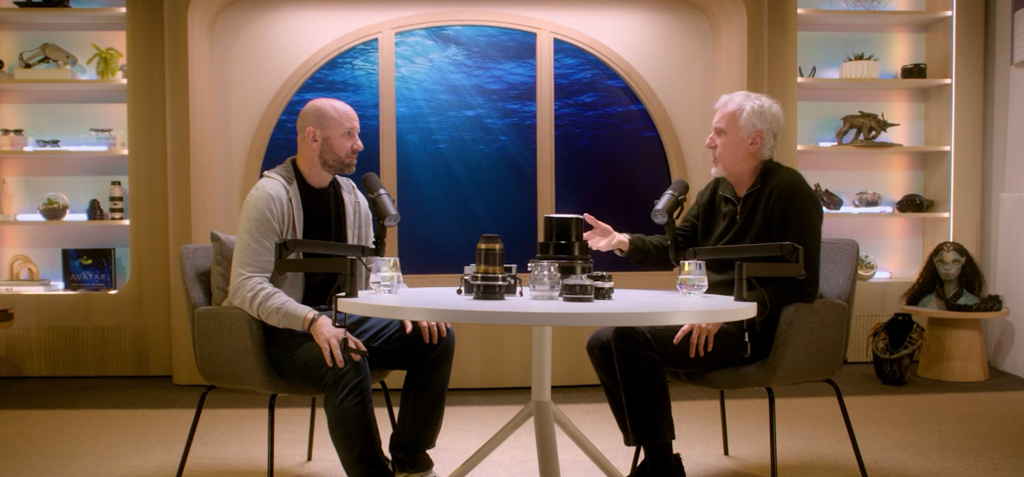
This slimmed-down form factor made a huge impression on James Cameron. In a podcast with Bosworth, he suddenly started talking about the upcoming headset, claiming XR is “about to blow open over the next few years with some of the new devices that you’ve shared with me,” and asks, “Can I talk about that?” Bosworth cuts him off with a hard no, but Cameron adds it will be “very f*****g cool,” that it “feels like a theater,” and that Meta has “smoked past” the competition. Having someone of Cameron’s stature this excited is definitely noteworthy.
Resolution and Software
Luna’s firmware digs point to Qualcomm’s new Snapdragon Reality Elite, the same chip built for puck configurations that XREAL is putting in its Aura. Displays are a bit less certain, with a single Chinese outlet claiming 2560×2560 micro-OLED panels from SeeYA. This is not a lot to go on, but if this news holds up, expect a narrower field of view in exchange for higher pixel density. Above Quest 3 but slightly below Apple Vision Pro.
On the software front, Phoenix leans into virtual screens and immersive video. A Horizon OS overhaul codenamed Display Evo ditches the three-window layout for freely placed, snappable panels. The expectation is that since Phoenix uses the same operating system as Quest, it will be backward compatible with the existing library of apps and games. This might be true, but a lot will depend on whether Phoenix supports motion controllers or hand tracking only. For what it is worth, Bosworth confirmed games are “absolutely” happening on Phoenix.
Gaze-and-Pinch Input
Another big break from Quest and toward Apple Vision Pro is input. The default scheme is gaze-and-pinch powered by eye and hand tracking. As mentioned, motion controller support might survive as an optional add-on, and Luna reports early developer units did pair with the Touch Plus controllers, but given the scale of the pivot toward gaze-and-pinch, this is not a certainty. Meta is also building an “Eye Unlock” biometric feature, which is its own take on Optic ID, and prescription wearers will need inserts that pair with the headset. Those same inward-facing sensors also point to the long-awaited Codec Avatars finally making an official appearance, possibly shipping under a new “Hologram” branding.
The name: Meta Pegasus?
The headset has been known over the last two years as Project Phoenix. That being said, a plethora of other codenames have been surfacing from time to time. The Quest Air, Loma, Stanley, and most recently Pegasus. What Luna has discovered is that all customer-facing retail pages have recently been rebranded with this new name. Among all the suggestions floating around, this makes Pegasus a frontrunner.
Even though Apple Vision Pro did not achieve outstanding sales, it has pioneered a number of solutions like gaze-and-pinch, an AR-first approach with high-quality passthrough, and a tethered battery pack. Samsung Galaxy XR, Pico Space Pro, and URXR One are all following Apple’s playbook while promising something new at a lower price. Compared to Apple Vision Pro, Meta’s upcoming headset might seem like a good deal, but compared to Quest 3 and Quest 3S it will be eye-wateringly expensive. If Meta can get the price down to $2,000 or less, it will undercut not just Apple Vision Pro but many other competitors.