ByteDance Announces PICO Space Pro, Then Cancels the Reveal
 VR Guru·
3 MIN READ
VR Guru·
3 MIN READ
Update (August 25, 2026): PICO has cancelled the September 2 reveal. In a statement posted to Chinese social media, the company said it is moving the PICO Space Pro release to Q4 2026, explaining that it wants more time to deliver a “major upgrade” to the software. PICO also said it is expanding its early access program, inviting more users to test the headset ahead of release. The original article follows below.
After months of industry speculation surrounding the codename “Project Swan,” ByteDance-owned PICO has officially confirmed its next-generation headset: the PICO Space Pro. The reveal date is set for September 2, 2026.
Weight, Dual Silicon and 4K Clarity
Because there has already been a lot of information (as well as leaks) regarding Project Swan, there is a fairly good understanding of what to expect. The headset will feature custom Micro-OLED displays reaching ~4,000 PPI, which equates to dual 4K-level clarity with an angular resolution between 40 and 45 PPD in the central sweet spot. For comparison, Apple Vision Pro offers around 3,400 PPI.
Driving these visuals will be Qualcomm’s dual-chip architecture. Two chips mean double the CPU and GPU performance of standard standalone XR processors. PICO Space Pro will not be a gaming device, so this extra power will be there mostly to handle heavy spatial multitasking. As for weight, the device is reported to be around 270 grams (without the external compute pack), which again looks very impressive, especially when compared with Apple Vision Pro, which weights around 750 grams without the pack.
轻启全新空间体验
The headset’s official slogan, “轻启全新空间体验” can be literally translated as “Unlock a brand-new spatial experience.” There is, however, some wordplay involved, and Chinese press has zeroed in on the fact that the first character is 轻, which stands for “light” but also “gentle”. In this context this would mean something more like “Gently (lightly) unlock a brand-new spatial experience”. I am sure this reads much smoother in Chinese.. but the point is the announcement puts a lot of emphasis on the device’s weight.
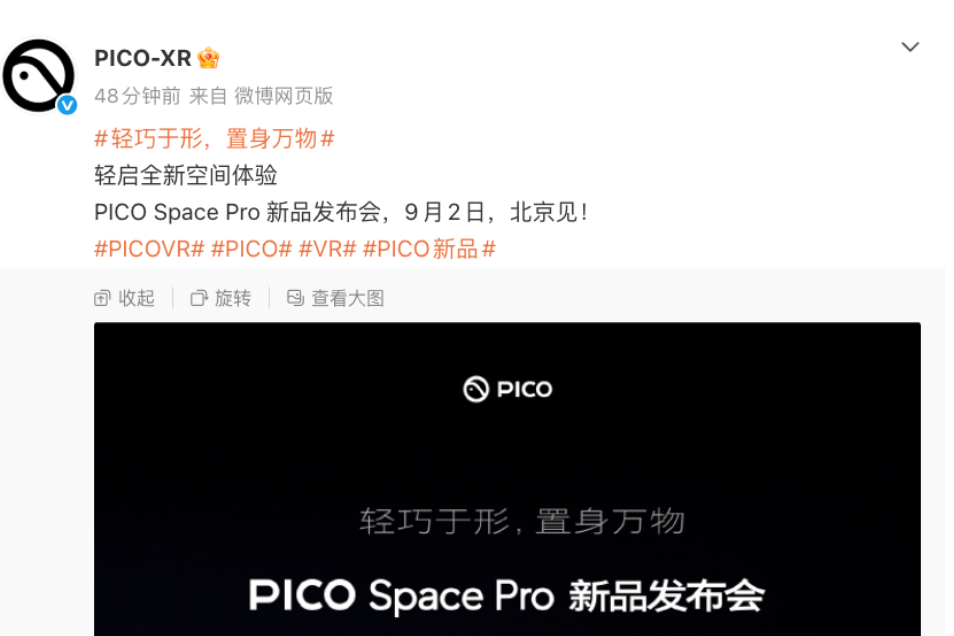
What the reveal also tells us is that we should not expect PICO Space Pro in the US or Europe anytime soon (if at all). There is no equivalent slogan in English, and the announcement was only promoted through Chinese and Japanese channels.
The Vision Pro Playbook
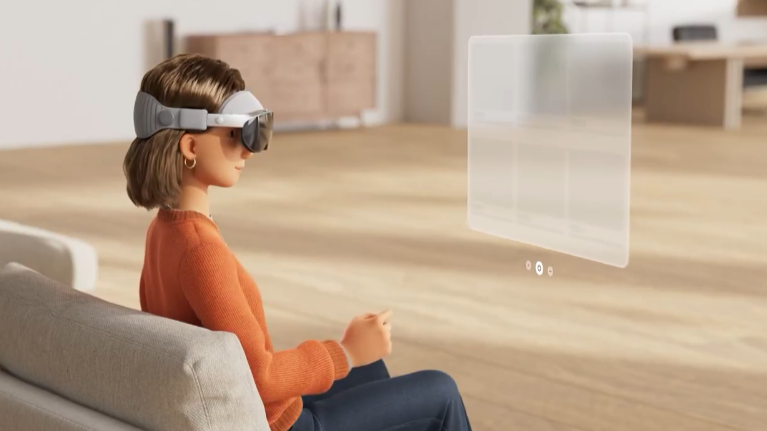
The announcement did not happen in a vacuum. From its naming convention to design, the Space Pro clearly wants to mirror Apple Vision Pro. Similarly, on the software front, PICO OS 6 introduces a spatial layer that mirrors visionOS by putting floating 2D windows natively in 3D physical surroundings. These windows can be positioned along 3D models, splats, other people’s avatars, and additional spatial objects. PICO is also backing WebSpatial, an open-source development framework enabling spatial apps to be built with standard web stacks alongside OpenXR.

With so many similarities, it is obvious the new device is positioned primarily as an Apple Vision Pro competitor (rather than, for example, a PICO 4 successor). It is also reasonable to assume that the difference in price will be the main draw. The margin by which PICO is attempting to undercut Apple is not certain, but a device that is half the price of AVP is definitely plausible. The reveal on September 2 should provide an answer.